YAMLRocks vs yamlium
yamlium is a pure-Python, dependency-free YAML library that preserves comments and structure through a manipulation API, a real feature for a zero-dependency package. Where YAMLRocks pulls ahead is everything around that: it is one to two orders of magnitude faster, it commits to YAML 1.2 and proves it against the test suite, and it adds native includes and schema validation that yamlium has no equivalent for.
Feature comparison
Section titled “Feature comparison”| Feature | yamlium | YAMLRocks |
|---|---|---|
| Comment-preserving round-trip | Yes | Yes (byte-for-byte) |
Native !include + writeback | No | Yes |
| JSON Schema validation | No | Yes (line-numbered) |
| Source line/column | No | Yes (annotated mode) |
| Verified vs the YAML suite | Not stated | Yes, in full |
| Declared YAML version | Undocumented | 1.2 (1.1 optional) |
| Anchors / merge keys | Preserved / yes | Preserved / yes |
| Implementation | Pure Python | Rust extension |
| Speed (parse / dump) | baseline | ~42x / ~11x faster |
Speed: Rust vs pure Python
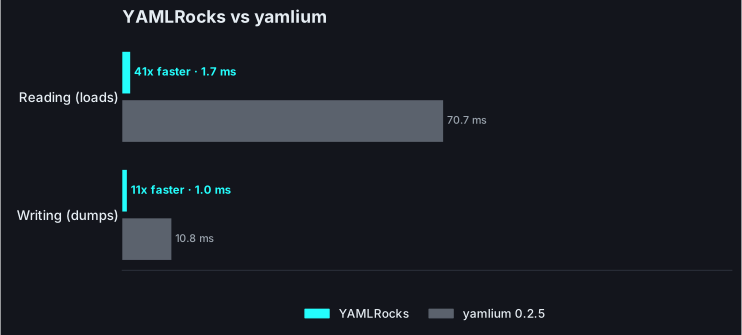
Section titled “Speed: Rust vs pure Python”yamlium is pure Python, which makes it portable but slow. YAMLRocks does the same work in Rust, one to two orders of magnitude faster on both directions.
| Operation | yamlium | YAMLRocks | YAMLRocks is |
|---|---|---|---|
| Reading | ~71 ms | ~1.7 ms | ~42x faster |
| Writing | ~11 ms | ~1.0 ms | ~11x faster |
Same round-trip, more of everything else
Section titled “Same round-trip, more of everything else”yamlium’s comment-and-structure-preserving editing is its selling point, and
YAMLRocks matches it: load with OPT_ROUND_TRIP, edit through a node API, and
re-emit with comments, anchors, and layout intact, byte-for-byte when unmodified.
On that same foundation YAMLRocks adds what yamlium does not have:
- Native
!includewith file-aware write-back across a split configuration. - JSON Schema validation with line-numbered errors.
- Annotated mode with the source line and column on every node.
- Safe-by-default loading and correct YAML 1.2 typing.
See round-trip editing, includes, schema validation, and annotated mode.
Correctness, verified rather than assumed
Section titled “Correctness, verified rather than assumed”YAMLRocks commits to the YAML 1.2 core schema and checks it against the entire official test suite in CI. yamlium does not document which YAML version it targets, and its scalar resolution lands between the two in surprising ways:
import yamlrocks
yamlrocks.loads(b"mode: 0777")  # {'mode': '0777'}  a string, per YAML 1.2yamlrocks.loads(b"mask: 0o17")  # {'mask': 15}      the 1.2 octal# yamlium returns {'mode': 777} and {'mask': '0o17'}.
When you cannot tell which spec a library follows, you cannot tell what a value will become. YAMLRocks makes that explicit and pins it.
Where yamlium is a reasonable pick
Section titled “Where yamlium is a reasonable pick”yamlium is a fair choice when you specifically need a pure-Python, zero-dependency package (no binary wheel to install) and can accept its speed and its scalar quirks. Its comment-editing API is nicely done.
When to choose YAMLRocks
Section titled “When to choose YAMLRocks”Choose YAMLRocks when you can install a wheel and want the same comment-preserving round-trip with real speed, native includes, schema validation, source locations, and correctness that is verified rather than undocumented.
See also
Section titled “See also”- Round-trip editing: the comment-preserving workflow.
- YAMLRocks vs ruamel.yaml: the other round-trip comparison.
- Performance: the benchmark methodology.