YAMLRocks vs strictyaml
strictyaml takes a strong position: YAML’s implicit typing and its more exotic features are footguns, so it parses only a restricted subset and makes you supply a schema to get anything other than strings. The concern is real. The remedy is heavy: strictyaml is pure Python built on ruamel.yaml, it removes large parts of YAML, it is load-only, and it is the slowest option in the field by a wide margin. YAMLRocks answers the same concern by defaulting to YAML 1.2 and offering real JSON Schema validation, without throwing away YAML or the speed.
The concern, and how YAMLRocks addresses it
Section titled “The concern, and how YAMLRocks addresses it”strictyaml’s headline argument is the “Norway problem”: in YAML 1.1, no becomes
boolean False, so a country list containing NO (Norway) silently corrupts.
YAMLRocks does not have this problem, because it defaults to the YAML 1.2 core
schema, where no is the string "no".
import yamlrocks
yamlrocks.loads(b"countries: [NO, SE, DK]")# {'countries': ['NO', 'SE', 'DK']}   strings, not [False, 'SE', 'DK']
Where strictyaml removes implicit typing entirely and hands you strings, YAMLRocks gives you correct 1.2 types by default and lets you enforce a shape with JSON Schema validation that reports line-numbered errors. You get type safety without giving up numbers, booleans, or a dumper.
Feature comparison
Section titled “Feature comparison”| Feature | strictyaml | YAMLRocks |
|---|---|---|
Implicit no -> False | Avoided (subset) | Avoided (1.2 default) |
| Typed values without cast | No (strings only) | Yes (1.2 core schema) |
| Schema validation | Yes (own schema DSL) | Yes (JSON Schema) |
| Anchors/aliases | Rejected by design | Yes (preserved) |
Flow style {} / [] | Rejected by design | Yes |
| Custom tags | Rejected by design | Yes |
| Dumping arbitrary data | No general dumper | Yes |
| Comment preservation | Yes (via ruamel) | Yes |
| Implementation | Pure Python (ruamel) | Rust extension |
| Speed (parse) | baseline | ~810x faster |
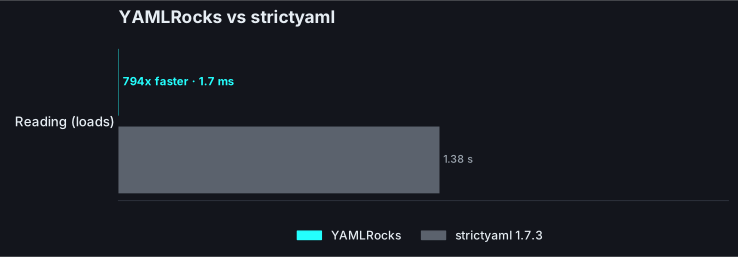
strictyaml is built for a specific safety story, not for throughput, and it shows: it is roughly three orders of magnitude slower to load than YAMLRocks, and it has no general-purpose dumper to benchmark at all.
| Operation | strictyaml | YAMLRocks | YAMLRocks is |
|---|---|---|---|
| load | ~1.38 s | ~1.7 ms | ~810x faster |
| dump | no dumper | ~1.0 ms | - |
What strictyaml gives up
Section titled “What strictyaml gives up”To enforce its subset, strictyaml rejects flow style, anchors and aliases, and tags outright, and it returns every leaf as a string until a schema casts it. That is a deliberate, sometimes reasonable trade for a locked-down config format you fully control. But it means strictyaml cannot read a large fraction of real-world YAML, and it cannot write YAML back out as a drop-in dumper.
YAMLRocks reads all of standard YAML 1.2, is safe by default (it never constructs arbitrary Python objects from tags), types scalars correctly, validates against a schema when you want enforcement, and round-trips with comments intact.
When to choose YAMLRocks
Section titled “When to choose YAMLRocks”Choose strictyaml only if you specifically want a maximally restricted YAML dialect and are willing to pay for it in speed and in features. For everything else, safe loading, correct 1.2 types, schema-enforced validation, reading real-world YAML, round-trip editing, and speed, YAMLRocks covers the same safety goals without the sacrifices.
See also
Section titled “See also”- Schema validation: enforce a shape with line-numbered errors.
- YAML 1.1 vs 1.2: why the Norway problem does not happen by default.
- YAMLRocks vs PyYAML and performance.