YAMLRocks vs oyaml
oyaml is not a separate YAML implementation. It
is a small shim that imports PyYAML, registers ordered-dict representers and
constructors, and re-exports PyYAML’s entire API. You use it as import oyaml as yaml. Its one job was preserving mapping key order, which mattered before Python
3.7. Since then, dicts are ordered by the language and modern PyYAML already keeps
insertion order, so oyaml adds essentially nothing.
What oyaml actually is
Section titled “What oyaml actually is”Everything oyaml does, PyYAML does. Its speed, its YAML 1.1 semantics, its comment handling (none), its safety story, all of it is PyYAML’s, because it is PyYAML underneath. So the real comparison is YAMLRocks vs PyYAML, and it applies here unchanged.
| Feature | oyaml (= PyYAML) | YAMLRocks |
|---|---|---|
| Distinct implementation | No (PyYAML) | Yes (Rust extension) |
| Preserves key order | Yes (its point) | Yes |
| YAML 1.2 by default | No | Yes |
| Comment preservation | No | Yes |
| Round-trip (byte-for-byte) | No | Yes |
Native !include | No | Yes |
| JSON Schema validation | No | Yes |
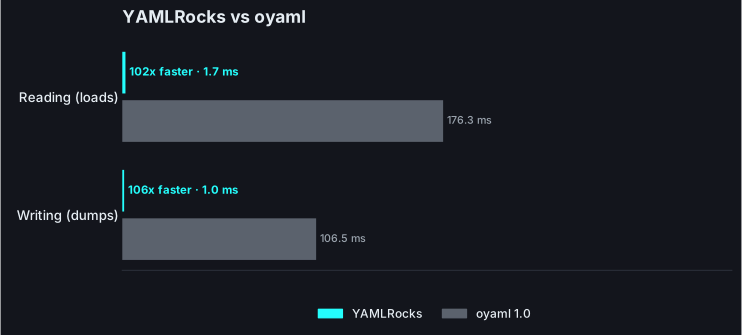
| Speed (parse) | baseline | ~104x faster |
| Speed (dump) | baseline | ~107x faster |
Order preservation is free now
Section titled “Order preservation is free now”YAMLRocks preserves mapping key order as a matter of course, the same as any modern dict. There is nothing to add a shim for.
import yamlrocks
yamlrocks.loads(b"z: 1\na: 2\nm: 3\n")# {'z': 1, 'a': 2, 'm': 3}   source order, always
When to choose YAMLRocks
Section titled “When to choose YAMLRocks”There is no scenario where oyaml is preferable to plain PyYAML on a supported Python, and none where it beats YAMLRocks. If you are on oyaml today, you are on PyYAML with a patch that no longer does anything; move straight to YAMLRocks for YAML 1.2, comment-preserving round-trip, native includes, schema validation, and one to two orders of magnitude more speed.
See also
Section titled “See also”- YAMLRocks vs PyYAML: the comparison that actually applies to oyaml.
- Migrating from PyYAML.
- Performance.