YAMLRocks vs ryaml
ryaml is a Rust-backed YAML reader with a
deliberately small, json-module-style API. It is a fine way to turn a trusted
file into Python data, but that is all it does, and it is alpha software. YAMLRocks
is the full configuration toolkit, comment-preserving round-trip, native
includes, schema validation, source locations, and verified-correct parsing, and
it is several times faster.
Feature comparison
Section titled “Feature comparison”| Feature | ryaml | YAMLRocks |
|---|---|---|
| Comment-preserving round-trip | No | Yes (byte-for-byte) |
Native !include + writeback | No | Yes |
| JSON Schema validation | No | Yes (line-numbered) |
| Source line/column | No | Yes (annotated mode) |
| Custom tag handling | No | Yes |
| Verified vs the YAML suite | Not stated | Yes, in full |
Merge keys (<<) | No | Yes |
| Anchors/aliases resolved | Yes | Yes |
| Implementation | Rust (libyaml-safer) | Rust (own scanner/emitter) |
| Speed (parse / dump) | baseline | ~2.8x / ~3.4x faster |
| Maturity | 0.5.x, alpha | Battle-tested corpus |
A parser, or a toolkit
Section titled “A parser, or a toolkit”ryaml reads YAML into Python and stops. YAMLRocks does that and the rest of what a real configuration workflow needs:
- Comment-preserving round-trip. Edit a value and re-emit with comments, anchors, and layout intact; an unmodified document is byte-for-byte identical. ryaml drops comments and formatting, so it can read a file but not edit one.
- Native
!includewith file-aware write-back across a split configuration. - JSON Schema validation with line-numbered errors.
- Annotated mode with the source line and column on every node.
- Custom tag handling, and safe-by-default loading that never builds arbitrary Python objects.
See round-trip editing, includes, schema validation, and annotated mode.
Both are Rust extensions, so this is Rust vs Rust. YAMLRocks is well ahead on both.
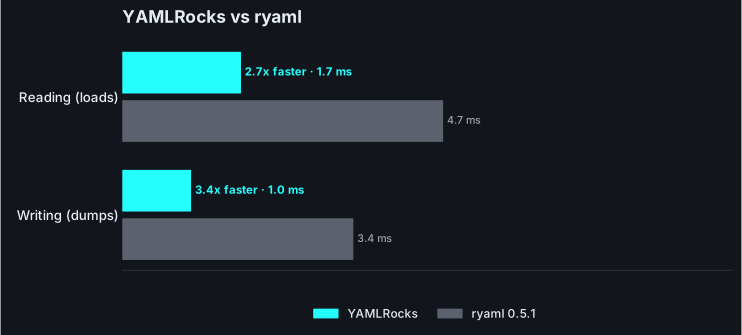
| Operation | ryaml | YAMLRocks | YAMLRocks is |
|---|---|---|---|
| Reading | ~4.7 ms | ~1.7 ms | ~2.8x faster |
| Writing | ~3.4 ms | ~1.0 ms | ~3.4x faster |
Correctness, verified rather than assumed
Section titled “Correctness, verified rather than assumed”YAMLRocks’s parsing is checked against the entire official YAML test suite on
every change. ryaml publishes no such guarantee, describes itself as YAML 1.1 yet
resolves no and 0o17 the 1.2 way, and does not implement merge keys:
import yamlrocks
# Merge keys: YAMLRocks folds the base in; ryaml leaves `<<` as a literal key.yamlrocks.loads(b"base: &b\n  timeout: 30\nsvc:\n  <<: *b\n  name: api\n")# {'base': {'timeout': 30}, 'svc': {'timeout': 30, 'name': 'api'}}
The point is not one missing feature; it is that YAMLRocks commits to a schema and proves it, so you always know which reading you get.
Where ryaml is a reasonable pick
Section titled “Where ryaml is a reasonable pick”ryaml is a small, MIT-licensed, json-style reader. For quickly loading trusted
YAML 1.2 data with no writing and no merge keys, it is easy to reach for. It is
alpha (0.5.x) with a thin surface by design.
When to choose YAMLRocks
Section titled “When to choose YAMLRocks”Choose YAMLRocks when YAML is something you edit, validate, and depend on: round-trip with comments, includes, schema validation, and source locations, on a verified-correct parser that is also several times faster.
See also
Section titled “See also”- YAMLRocks vs yaml-rs and vs py-yaml12: the other Rust-backed parsers.
- YAMLRocks vs PyYAML: the safety and speed comparison.
- Performance: the benchmark methodology.