YAMLRocks vs py-yaml12
py-yaml12 is a Rust-backed YAML 1.2 parser (built on the saphyr crate) with genuinely good first-class custom-tag handling. It is a clean data parser, and its tag support is a real strength. But it is a one-way parser: it does not edit YAML, resolve includes, or validate against a schema, and YAMLRocks is both more complete and faster.
Feature comparison
Section titled “Feature comparison”| Feature | py-yaml12 | YAMLRocks |
|---|---|---|
| Comment-preserving round-trip | No | Yes (byte-for-byte) |
Native !include + writeback | No | Yes |
| JSON Schema validation | No | Yes (line-numbered) |
| Source line/column | No | Yes (annotated mode) |
| Custom tag handling | Yes (first-class) | Yes |
| Verified vs the YAML suite | Claims full | Yes, in full |
| Multi-document streams | Yes | Yes |
Merge keys (<<) | No | Yes |
| Implementation | Rust (saphyr) | Rust (own scanner/emitter) |
| Speed (parse / dump) | baseline | ~2.4x / ~1.4x faster |
A parser, or a toolkit
Section titled “A parser, or a toolkit”py-yaml12’s tag handling is legitimately nice: a Yaml(value, tag) wrapper and
handlers= callables transform tagged nodes at parse time. YAMLRocks matches that
(a tags= registry and a tag_handler) and then adds the whole
configuration-editing layer py-yaml12 has no answer for:
- Comment-preserving round-trip. Edit a value and re-emit with comments, anchors, and formatting intact; unmodified documents come back byte-for-byte. py-yaml12 reads data but cannot write an edited file back.
- Native
!includewith file-aware write-back across split configurations. - JSON Schema validation with line-numbered errors.
- Annotated mode with the source line and column on every node.
See custom tags, round-trip editing, includes, and schema validation.
Both are Rust extensions built for correctness and speed. YAMLRocks is faster on both directions.
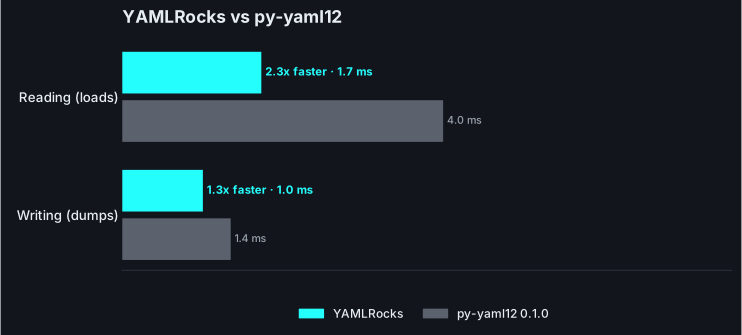
| Operation | py-yaml12 | YAMLRocks | YAMLRocks is |
|---|---|---|---|
| Reading | ~4.0 ms | ~1.7 ms | ~2.4x faster |
| Writing | ~1.4 ms | ~1.0 ms | ~1.4x faster |
Correctness, verified rather than assumed
Section titled “Correctness, verified rather than assumed”Both aim at YAML 1.2, and py-yaml12 states it targets the test suite. YAMLRocks runs that suite in CI on every change (load, round-trip, and canonical result all checked), and it also resolves merge keys and the 1.2 scalar edges py-yaml12 does not:
import yamlrocks
# Merge keys: YAMLRocks folds the base in; py-yaml12 leaves `<<` as a literal key.yamlrocks.loads(b"base: &b\n  timeout: 30\nsvc:\n  <<: *b\n  name: api\n")# {'base': {'timeout': 30}, 'svc': {'timeout': 30, 'name': 'api'}}
# `0777` is a string in YAML 1.2; py-yaml12 returns the number 777.yamlrocks.loads(b"mode: 0777")# {'mode': '0777'}
Where py-yaml12 is a reasonable pick
Section titled “Where py-yaml12 is a reasonable pick”For turning trusted YAML 1.2 data into Python objects with rich custom tags, py-yaml12 is a solid, MIT-licensed choice, and its tag API is genuinely good. If you never edit YAML, resolve includes, or need schema validation, it fits.
When to choose YAMLRocks
Section titled “When to choose YAMLRocks”Choose YAMLRocks when you want that same clean 1.2 parsing and tag handling plus the editing toolkit around it, comment-preserving round-trip, includes, schema validation, source locations, verified correctness including merge keys, and more speed.
See also
Section titled “See also”- YAMLRocks vs yaml-rs and vs ryaml: the other Rust-backed parsers.
- Custom tags and performance.