YAMLRocks vs PyYAML
PyYAML is the de-facto standard YAML library for Python. It is mature and widely used, but it is YAML 1.1 only, discards comments, has no round-trip mode, and its safest, fastest path still trails a modern Rust implementation. YAMLRocks is a drop-in-friendly alternative that is faster on every operation, safe by default, and far more capable.
Feature comparison
Section titled “Feature comparison”| Feature | PyYAML | YAMLRocks |
|---|---|---|
| YAML 1.2 | No (1.1 only) | Yes (1.2 default, 1.1 mode) |
| Speed (parse) | C loader | ~6-10x faster than the C loader |
| Speed (dump) | C dumper | ~17-19x faster than the C dumper |
| Comment preservation | No | Yes |
| Round-trip (byte-for-byte) | No | Yes |
| Anchors/aliases preserved | No | Yes |
Merge keys (<<) | Yes | Yes |
Native !include | No | Yes (with write-back) |
| Source line/column | No | Yes (annotated mode) |
| JSON Schema validation | No | Yes (line-numbered errors) |
| Arbitrary object construction | Yes (yaml.load) | None by design |
| Output type | str | bytes (no extra encode) |
| datetime/date/time dump | partial | Yes (with offset control) |
| Free-threaded (nogil) safe | No | Yes |
Safety: no arbitrary object construction
Section titled “Safety: no arbitrary object construction”PyYAML’s headline footgun is yaml.load with the default loader, which
constructs arbitrary Python objects from tags like !!python/object/apply. That
is remote code execution waiting to happen, which is why PyYAML added
safe_load and now warns when you call load without an explicit loader.
YAMLRocks has no unsafe path to forget. Tags never construct Python objects. An
unrecognized tag keeps its underlying scalar, or you opt in to handle it
yourself with a tag_handler or OPT_PASSTHROUGH_TAG:
import yamlrocks
# A tag never executes anything. The value is just the scalar underneath.yamlrocks.loads(b"value: !something 42")  # {'value': '42'}
# Opt in to interpret a tag, on your terms.yamlrocks.loads(    b"value: !double 5",    tag_handler=lambda tag, value: int(value) * 2 if tag == "!double" else value,)  # {'value': 10}
There is no yamlrocks.load that behaves like yaml.load. The safe behavior is
the only behavior. See security and
custom tags.
YAML 1.2 by default: the Norway problem
Section titled “YAML 1.2 by default: the Norway problem”PyYAML follows YAML 1.1, where yes, no, on, off, and the country code
NO parse as booleans. This famously corrupts configuration files. YAMLRocks
defaults to YAML 1.2, where those are plain strings:
import yamlrocks
yamlrocks.loads(b"country: NO")  # {'country': 'NO'}yamlrocks.loads(b"enabled: yes")  # {'enabled': 'yes'}
If you need the old behavior for a specific document, opt in with
OPT_YAML_1_1, and use yamlrocks.upgrade() to migrate
legacy 1.1 files to canonical 1.2:
import yamlrocks
yamlrocks.loads(b"enabled: yes", option=yamlrocks.OPT_YAML_1_1)  # {'enabled': True}yamlrocks.upgrade(b"enabled: yes\nmode: on\n")# b'%YAML 1.2\n---\nenabled: true\nmode: true\n'
The same 1.1 heritage means PyYAML also resolves implicit timestamps and
sexagesimals, so a plain 2024-01-15 becomes a datetime.date and a bare
13:30:45 becomes the integer 48645 (base-60), a config value silently turned
into a large number. YAMLRocks stays clean by default and makes timestamp typing
an explicit opt-in that never touches other 1.1 forms:
import datetimeimport yamlrocks
yamlrocks.loads(b"at: 13:30:45")  # {'at': '13:30:45'}yamlrocks.loads(    b"on: 2024-01-15", option=yamlrocks.OPT_TIMESTAMPS)  # {'on': datetime.date(2024, 1, 15)}
See YAML 1.1 vs 1.2 for the full list of differences, and timestamps for the opt-in.
Comments and round-trip editing
Section titled “Comments and round-trip editing”PyYAML throws comments away on load and cannot reproduce a file. There is no
supported way to load config.yaml, change one value, and write it back without
losing the comments and reflowing everything.
YAMLRocks’s round-trip mode preserves comments, anchors, and layout, and re-emits only what changed:
import yamlrocks
source = b"# service config\nname: app  # the app name\nport: 8080\n"doc = yamlrocks.loads(source, option=yamlrocks.OPT_ROUND_TRIP)doc["port"] = 9090doc.to_yaml()# b'# service config\nname: app  # the app name\nport: 9090\n'
The comment survives, and the unchanged lines are reproduced verbatim. See round-trip editing and the config editor recipe.
Bytes out, no extra encode
Section titled “Bytes out, no extra encode”yaml.safe_dump returns a str, so writing to a file or socket means a second
UTF-8 encode. yamlrocks.dumps returns bytes directly, ready to
write:
import yamlrocks
yamlrocks.dumps({"key": "value", "list": [1, 2]})# b'key: value\nlist:\n  - 1\n  - 2\n'
Native includes
Section titled “Native includes”PyYAML has no !include. The common workaround is a custom constructor that you
wire up yourself and that cannot write changes back. YAMLRocks resolves !include
and the !include_dir_* family natively, and round-trip mode can save an edited
value back into the exact file it came from. See includes
and the Home Assistant recipe.
Pain points YAMLRocks resolves
Section titled “Pain points YAMLRocks resolves”Beyond the headline differences above, YAMLRocks quietly fixes a long list of recurring PyYAML frustrations:
| Common PyYAML frustration | YAMLRocks |
|---|---|
| Install fails to build (Cython errors, no wheel for your platform or Python) | Pure Rust via maturin: prebuilt wheels, no C toolchain, and it builds and runs on free-threaded CPython and 3.14 |
An integer beyond 64 bits raises OverflowError on dump, or loads as a string | Arbitrary-precision integers load, dump, and round-trip exactly |
Large or small floats dump as long digit strings (1e308 becomes 309 digits) | Scientific notation matching Python’s repr (1.0e+308, 6.022e+23) |
Multi-line strings dump as one ugly "a\nb\n" line | A readable literal | block by default, with the right chomping |
OrderedDict, Decimal, Enum, UUID, or pathlib.Path raise RepresenterError | Serialized natively, no custom representer needed |
An unknown or custom tag raises ConstructorError | Kept as its underlying value, or surfaced as a YAMLRocksTag; never an error |
| Characters above U+FFFF (emoji, rare scripts) are mishandled | Full Unicode, including in escapes and as mapping keys |
yaml.dump output differs across platforms or appends a stray blank line | Deterministic output, exactly one trailing newline |
Each of these is exercised by the test suite, and the emitter’s output is checked to be yamllint-clean by default.
Performance
Section titled “Performance”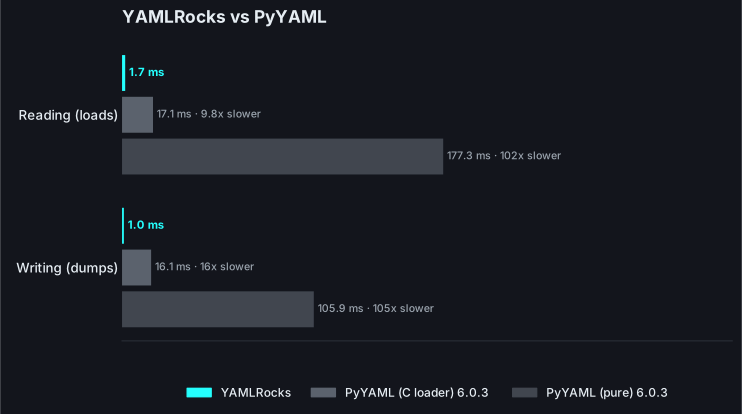
Indicative figures from python bench/bench.py (release build), showing how many
times faster YAMLRocks is than PyYAML. The C loader (libyaml) is the harder
target; the pure-Python loader is what most environments fall back to.
Parsing (loads)
| Payload | vs PyYAML (C) | vs PyYAML (pure) |
|---|---|---|
| small (10 lines) | ~8x faster | ~64x faster |
| medium (k8s manifest) | ~9x faster | ~80x faster |
| large (500 items) | ~10x faster | ~87x faster |
| deep (30 levels) | ~6x faster | ~69x faster |
Serializing (dumps)
| Payload | vs PyYAML (C) | vs PyYAML (pure) |
|---|---|---|
| small | ~18x faster | ~94x faster |
| medium | ~18x faster | ~92x faster |
| large | ~17x faster | ~86x faster |
| deep | ~17x faster | ~75x faster |
Split configuration with !include (Home Assistant style): YAMLRocks’s native
resolver versus a PyYAML !include constructor.
| Files | YAMLRocks is |
|---|---|
| 50 | ~17x faster |
| 200 | ~17x faster |
| 500 | ~17x faster |
Migrating
Section titled “Migrating”Use the compatibility shim for a near drop-in switch:
import yamlrocks.compat as yaml
yaml.safe_load(b"a: 1") # {'a': 1}yaml.safe_dump({"a": 1}) # 'a: 1\n' (a str, matching PyYAML)safe_load, safe_load_all, safe_dump, and safe_dump_all map straight
across, with sort_keys=True defaulting as it does in PyYAML. The shim’s load
and dump map onto the safe variants, because YAMLRocks never executes code from
tags. For new code, prefer the native loads/dumps API and its bytes output.
When to stick with PyYAML
Section titled “When to stick with PyYAML”PyYAML is a reasonable choice when you only need basic 1.1 loading, want zero
native dependencies, or rely on its custom Loader/Dumper extension points and
add_constructor/add_representer hooks. YAMLRocks does not expose those
constructor hooks; it provides tag_handler, OPT_PASSTHROUGH_TAG, and the
default callback instead. For everything else (speed, round-trip, includes,
validation, YAML 1.2, and safety) YAMLRocks is the upgrade.
See also
Section titled “See also”- Migrating from PyYAML: the full shim reference.
- YAMLRocks vs ruamel.yaml: the round-trip comparison.
- Security: the safety model in detail.
- Round-trip editing and includes.