YAMLRocks vs ruamel.yaml
ruamel.yaml is the reference for comment-preserving, round-trip YAML in Python. It is excellent and feature-rich, but it is pure Python and therefore slow. YAMLRocks offers the same round-trip fidelity, backed by Rust, at one to two orders of magnitude more throughput, and adds native includes and schema validation. YAMLRocks now scripts comments per node too (inline and leading); ruamel still wins on the most exhaustive comment surgery, covered honestly below.
Feature comparison
Section titled “Feature comparison”| Feature | ruamel.yaml | YAMLRocks |
|---|---|---|
| YAML 1.2 | Yes | Yes |
| Comment preservation | Yes | Yes |
| Round-trip (unmodified) | Close | Byte-for-byte |
| Anchors/aliases preserved | Yes | Yes |
Merge keys (<<) | Yes | Yes |
| Implementation | Pure Python | Rust extension |
| Speed (parse) | baseline | ~105-141x faster |
| Speed (dump) | baseline | ~160-208x faster |
Native !include + write-back | No | Yes |
| Source line/column | partial | Yes (annotated mode) |
| JSON Schema validation | No | Yes |
| Save only changed files | No | Yes |
| Per-node comment editing API | Yes (.ca, exhaustive) | Yes (inline, leading, trailing) |
| Output type | str (to a stream) | bytes |
Speed: Rust vs pure Python
Section titled “Speed: Rust vs pure Python”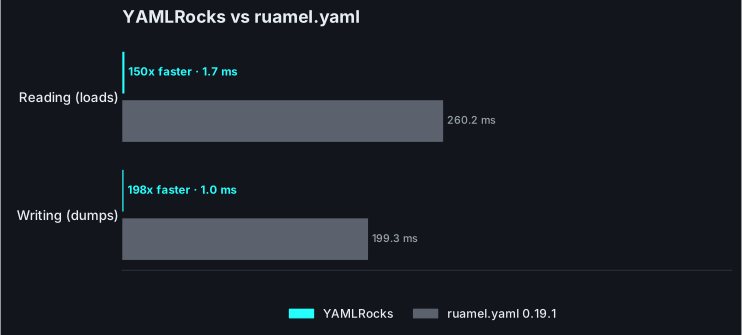
ruamel.yaml is implemented entirely in Python, which makes it flexible but slow. YAMLRocks does the same work in Rust and materializes results across the PyO3 boundary, so the same parse or dump is one to two orders of magnitude faster.
Indicative figures from python bench/bench.py (release build), showing how many
times faster YAMLRocks is than ruamel.yaml in safe mode.
Parsing (loads)
| Payload | YAMLRocks is |
|---|---|
| small | ~105x faster |
| medium | ~124x faster |
| large (500 items) | ~141x faster |
| deep | ~105x faster |
Serializing (dumps)
| Payload | YAMLRocks is |
|---|---|
| small | ~208x faster |
| medium | ~201x faster |
| large | ~199x faster |
| deep | ~163x faster |
ruamel’s round-trip mode is heavier still. YAMLRocks’s round-trip path stays far faster while preserving comments, anchors, and formatting, with byte-for-byte output for unmodified documents.
Byte-for-byte round-trip
Section titled “Byte-for-byte round-trip”Both libraries preserve comments, anchors, and scalar styles. YAMLRocks goes one step further: an unmodified round-trip reproduces the source bytes exactly, and only the nodes you change are re-rendered. This is enforced across the entire official YAML test suite.
import yamlrocks
source = b"# service config\nname: app  # the app name\nport: 8080\n"
# Unmodified: bytes come back exactly as they went in.doc = yamlrocks.loads(source, option=yamlrocks.OPT_ROUND_TRIP)assert doc.to_yaml() == source
# Change one value: only that line is re-rendered, comments intact.doc["port"] = 9090doc.to_yaml()# b'# service config\nname: app  # the app name\nport: 9090\n'
The editing surface is a YAMLRocksDocument with dict/list-style access plus
walk(), to_dict(), and range() helpers, rather than ruamel’s
CommentedMap/CommentedSeq types:
import yamlrocks
doc = yamlrocks.loads(    b"server:\n  host: localhost\n  port: 8080\n", option=yamlrocks.OPT_ROUND_TRIP)
doc.keys()  # ['server']doc["server"]["port"] = 9090  # nested edit writes throughdoc.to_dict()  # {'server': {'host': 'localhost', 'port': 9090}}doc.walk()  # [(('server', 'host'), 'localhost'), (('server', 'port'), 9090)]
See round-trip editing and the config editor recipe.
Native includes and file-aware saving
Section titled “Native includes and file-aware saving”ruamel.yaml has no !include. A split configuration must be stitched together by
hand, and there is no concept of writing an edited value back to the specific
file it came from.
YAMLRocks resolves !include and the !include_dir_* family natively. In
round-trip mode each node remembers its source file, so save() writes back
only the files that actually changed. See includes and the
Home Assistant recipe for a worked example of
editing one automation and saving only automations.yaml.
Scripting comments
Section titled “Scripting comments”YAMLRocks does more than preserve comments through a round-trip: every
YAMLRocksNode exposes a writable comment (the inline # ... after a value),
comment_before (the standalone line(s) above a key), and comment_after (the
trailing block at the foot of a mapping or sequence). A tool can read, add, edit,
remove, or move a comment (read it from one node, set it on another) and re-emit.
This works on mapping values, keys, and sequence items alike, and on keys you add
to a loaded document.
import yamlrocks
doc = yamlrocks.loads(b"name: app\nport: 8080\n", option=yamlrocks.OPT_ROUND_TRIP)
doc.node["port"].comment = "the listen port"  # inline, no '#'doc.node["name"].comment_before = "service identity"  # standalone line abovedoc.node.comment_after = "end of config"  # trailing block (foot)doc.to_yaml()# b'# service identity\nname: app\nport: 8080 # the listen port\n# end of config\n'
Where ruamel.yaml is still richer
Section titled “Where ruamel.yaml is still richer”Building a fully commented document from nothing needs ruamel: YAMLRocks edits
comments on a loaded document rather than assembling one with no parsed source.
ruamel’s .ca API also reaches a few unusual placements that comment,
comment_before, and comment_after do not.
On emitter configuration the two are closer than they once were: YAMLRocks’s
dumps takes an explicit width, indentation options (OPT_INDENT_2 / _4,
OPT_INDENTLESS_SEQUENCES), a default= hook for serializing custom objects, and
a tags= registry, so most representer-style needs are met. ruamel remains more
configurable for deeply custom class round-tripping and is battle-tested for
intricate document transformations.
When to stick with ruamel.yaml
Section titled “When to stick with ruamel.yaml”Reach for ruamel.yaml when you need to build a fully commented document from scratch, lean on its class-based representer/constructor extension points for deeply custom types, or perform intricate document surgery where its maturity matters more than throughput. For high-throughput loading and dumping, native includes, schema validation, scripting inline, leading, and trailing comments, or byte-for-byte round-trip with file-aware saving, YAMLRocks is the faster, batteries-included choice.
See also
Section titled “See also”- Migrating from ruamel.yaml.
- YAMLRocks vs PyYAML: the safety and speed comparison.
- Round-trip editing and includes.
- Performance: the benchmark methodology.